
The book examines the transformation of marketing from traditional mass communication and broad market segmentation to an increasingly intelligent, data-driven and customer-centred discipline. Historically, marketers relied heavily on experience, intuition and limited consumer information to shape campaigns and strategic decisions. Today, Artificial Intelligence is fundamentally changing this landscape by enabling organisations to analyse vast datasets,
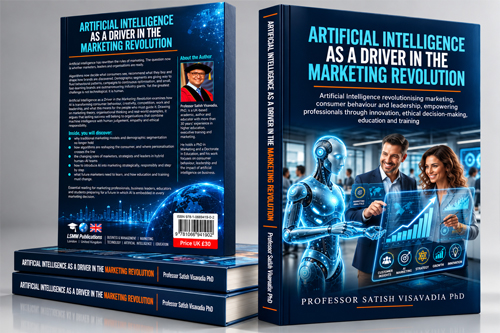
predict consumer behaviour, personalise experiences, automate marketing activities and respond to changing markets in real time. Looking ahead, AI will increasingly influence strategic decision-making, creativity, customer engagement, brand development and competitive advantage. The future marketers and leaders will need to consider further eduaction and training to understand the application of Artificial Intelligence, including its capabilities, limitations, ethical implications and strategic applications. The book therefore positions AI not simply as another technological tool, but as a powerful driver of the continuing marketing revolution, where human creativity, professional judgement and technological intelligence must work together to create sustainable value and meaningful customer relationships.
Transforming Management, Leadership, and Workforce
Leaders and Managers in the Age of Artificial Intelligence: Transforming Management, Leadership, and Workforce examines how AI is redefining leadership, management and organisational performance. The book traces the transition from industrial-era models based on hierarchy, control, efficiency and standardisation towards increasingly intelligent,
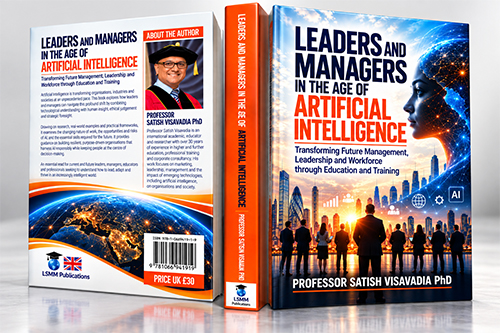
data-driven and adaptive organisations. Today, AI and automation are transforming decision-making, workforce structures, productivity and collaboration, requiring managers to combine technological awareness with strategic judgement, emotional intelligence, agility and ethical responsibility. Future leaders and managers must consider training and education to understand the implications and applications of Artificial Intelligence, including its capabilities, limitations, risks and responsible organisational applications. Looking ahead, the book argues that effective leadership will depend increasingly on productive human–AI collaboration rather than competition between people and technology. Leaders must champion continuous learning, workforce reskilling, innovation and responsible AI governance while maintaining human accountability. Ultimately, AI should become a strategic partner for building resilient, inclusive, sustainable and purpose-driven organisations prepared for an increasingly intelligent and rapidly changing global future.
The book explores how adult learning principles strengthen homeopathic education while integrating artificial intelligence across professional application and time. In the past, early digital repertories and computer based case documentation improved information storage, faster remedy search, and systematic analysis. Significant developments in
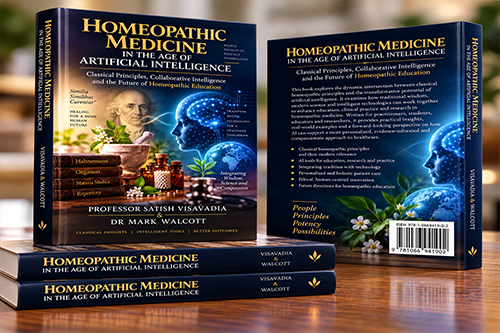
AI today offers major advantages such as personalised learning pathways, adaptive assessments, virtual case simulations, data-driven repertorisation, and instant access to global materia medica resources, enhancing accuracy and clinical and professional confidence. Looking to the future, AI promises predictive analytics, intelligent clinical decision support systems, real-time global knowledge networks, and advanced pattern recognition that may refine remedy selection and research outcomes. The book emphasises that when guided by andragogical principles, AI becomes a powerful educational partner, combining technological efficiency with human judgment, ethical responsibility, and the philosophical foundations of homeopathy remedies and practice.